

Annual Report 2025

Support Us
How to Bring Artificial Intelligence into the Classroom

Gabriel is one of the teachers transforming Romanian education from within. He is choosing to keep up with the world we live in, relying on a laptop, an open mind, and a deep curiosity about the generations of young people who keep changing before his eyes.
When he first walked into a classroom as a high school teacher, Gabriel Gabor was 27 and coming from the banking sector, where he had worked in marketing.
He hadn’t planned for a career in teaching, but after the 2009 financial crisis, a colleague suggested he try taking the certification exam to become a teacher. That’s how he ended up teaching marketing, management, business administration, and other economics courses at the “Ion Ghica” Economic High School in Bacău.
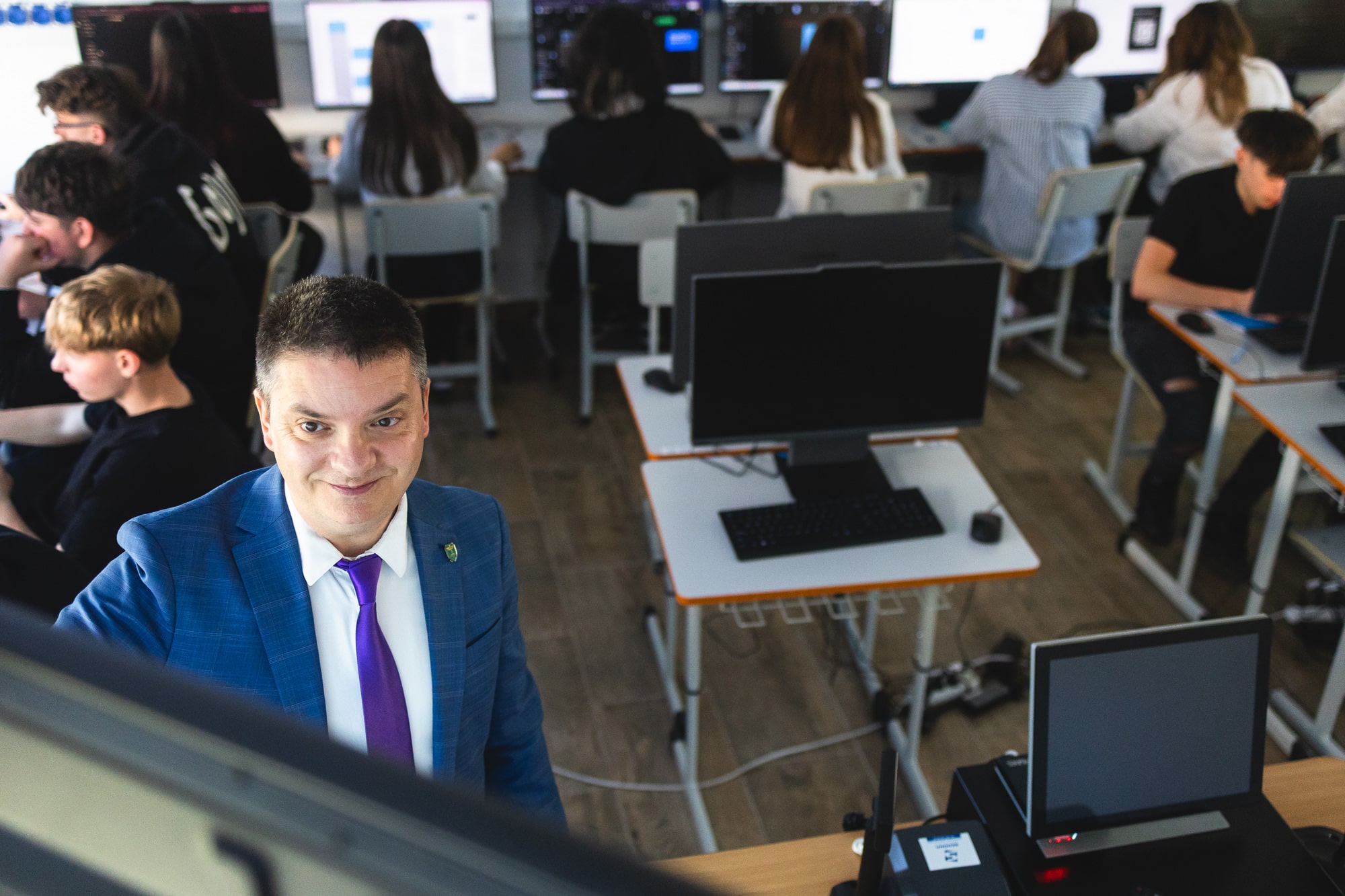
He stayed because he felt the need to keep sharing his stories. Coming from a practical field, he always found a real-life example that tied into the textbook theory. At the same time, he watched people grow right before his eyes. “My stories from my previous sales work integrated naturally into the course structure, giving substance to the theoretical concepts”
Today, he is also the vice-principal of that same high school – one with 1,244 students, nearly 70% of whom come from rural areas, and 453 of whom receive financial aid. He knows exactly what that means in practice: students who catch the 7 a.m. bus, who won’t make it to the first few classes if they miss the bus, who sometimes spend 12 hours of their time on a six-hour school day. For this reason, there are also parents who no longer encourage their children to finish high school: “The dropout rate remains low because I chose an approach based on understanding and flexibility. We analyze each case individually, adapting to the specific needs of the students to ensure they complete their studies”, explains the vice-principal.
In 2022, when the Own Your Path program came to his high school, Gabriel took on the task of identifying high school students with potential and in need of support. He had prior experience because he was also part of the committee that awarded state-funded scholarships; he already knew who the students were and what their social backgrounds were. Own Your Path helped high school students gain confidence in their abilities, meet role models, and discover what the future might hold. Some say that practicing English gave them the courage to speak, to travel, and to express themselves in front of others. Others recall that the tutoring sessions never started directly with the lesson – the teachers would first ask them how they were feeling. And others speak highly of the Digital Skills courses and the exercises in which they imagined what the future would look like. For example, a student who wants to become an agricultural engineer appreciated the Artificial Intelligence concepts because “modern technologies, including Artificial Intelligence, are being used more and more in agriculture.” A high school student said that the workshop on Artificial Intelligence was “exactly what I needed to understand the direction the future is heading.”
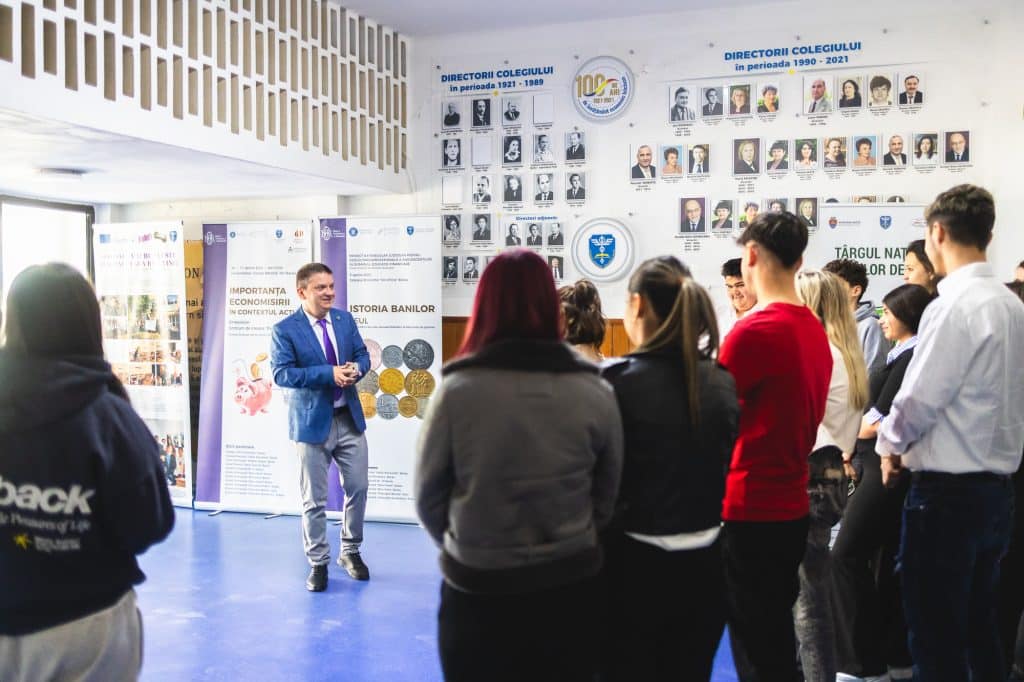
In the fall of 2025, when he met the new generation of high school students, Mr. Gabor was amazed at how different they seemed from previous generations.“I felt the need to get closer to their vision of life and technology.” That’s why he signed up for the course on Artificial Intelligence for teachers, organized by the Foundation.
“It was eye-opening,” he says. Until then, he thought AI was just a better version of Google. The course changed his understanding and introduced him to a tool he quickly integrated – first into administrative work, then into work, then into teaching: lesson plans, worksheets, presentations, and adapting content to each class’s level. “In Marketing classes, I can extract a passage from the work of Philip Kotler – the father of modern marketing management – and ask Artificial Intelligence algorithms to transpose it into language that is intelligible and resonant for a 16-year-old teenager. The output is then filtered and refined by my professional expertise to ensure full alignment with the specific characteristics of the class. At the same time, I systematically implement feedback mechanisms through longitudinal questionnaires administered at the beginning and end of the school year, with the purpose of mapping students’ mental architecture and their perception of phenomenological reality. By identifying their preferred cultural archetypes – from iconic film characters to the world of prestigious brands – I can frame case studies within a horizon of interest that catalyzes the learning process”, says Gabriel.
The first lesson he taught after his course was about AI Ethics and Deep Fake, to help students understand what a deep fake is and where they might encounter it (images, videos, social media), to distinguish between using basic visual cues, to critically analyze an image or video, and ask themselves questions such as: “Is this real?”, “Who created this content?”.
He realized that the students had knowledge of artificial intelligence tools, but the information was not structured, verified, or debated alongside parents or teachers. In the course, he filled in the gaps and organized the information.
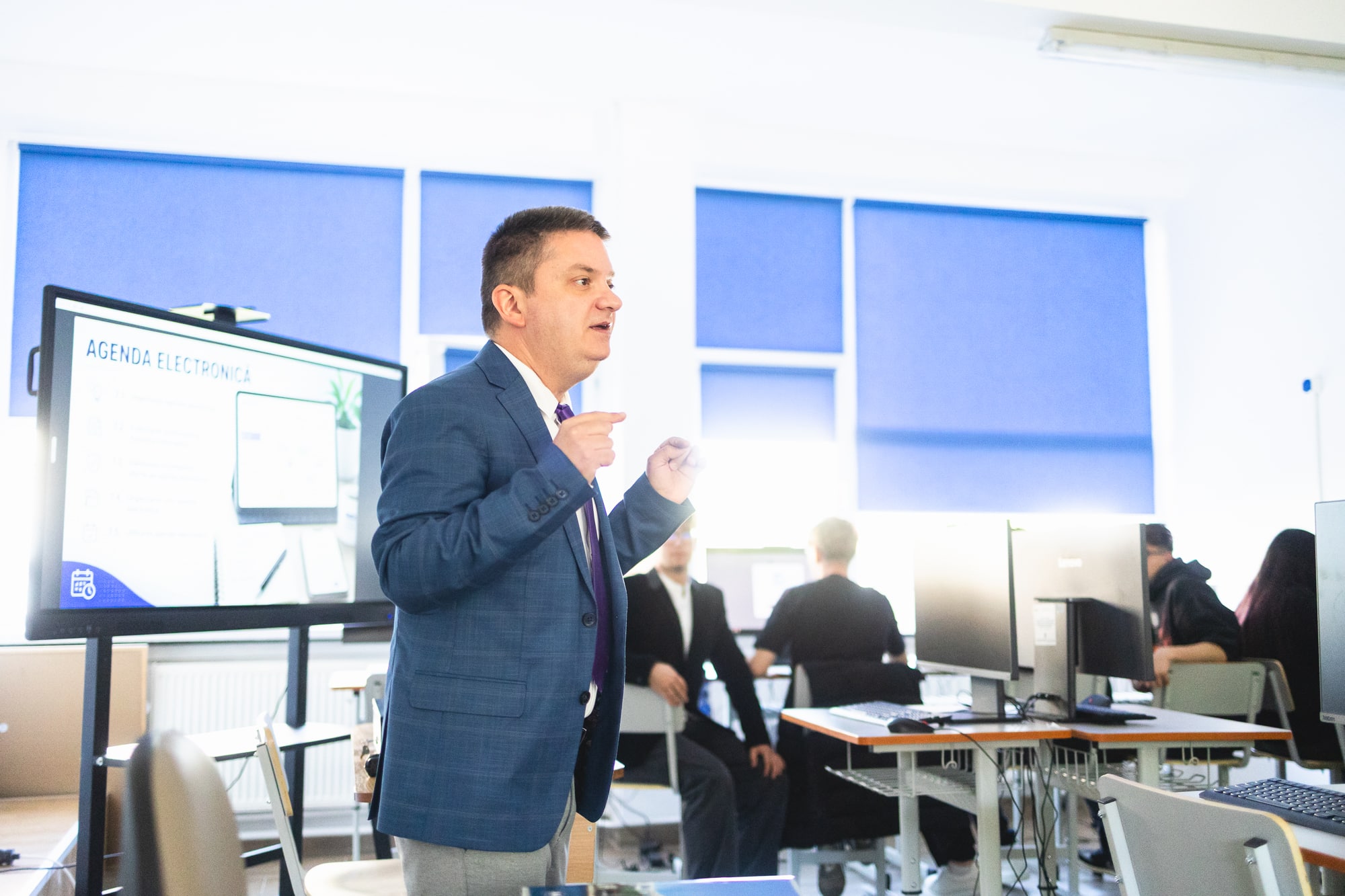
Since then, when he assigns homework that can be solved with AI, he openly tells them what tools are available and how they work: ChatGPT, Gemini, Perplexity. He doesn’t stop them; he doesn’t pretend he doesn’t know they’re using them. There’s only one condition: they must present the result to the class – as if they had created it themselves – on the projector, explaining every decision. “The moment you generate content and are required to explain it to your colleagues”, he says, “the learning process becomes mandatory”. It’s a different form of assessment than the classic report, which puts students in the position of taking ownership of what they produce, regardless of the help they receive.
He also speaks openly about the limitations of this approach. There are students who will copy without filtering, who will bring exactly what the Artificial Intelligence gave them and they don’t know three sentences of what’s written there. “They wonder, afterward, why they got such a low grade.” He sees them too. But he believes the solution isn’t to ban the tool, but to change the assignment and ask for something that can’t be presented to the class without being understood first.
Now he wants to take it further. He’s planning a course that integrates AI into the module where 11th-grade students will learn how to start a business. They’ll register a company from scratch, but they’ll also create promotional materials, presentations, and commercials – and they’ll be allowed to create them using AI.
The teacher was also part of the first round of consultative discussions regarding AI Generation, the high school curriculum designed by UiPath Foundation to develop AI literacy. In the teachers’ room and during breaks, he shares with his colleagues what he has discovered and what works. He sent information about the course he attended to the 100 teachers in his school and continues to talk about it whenever he gets the chance, because he is convinced that Artificial Intelligence is entering the classroom anyway, with or without teachers prepared to handle it.

About a Light that Travels Further
…but also about what happens when a light is shared freely.
In May 2025, we did something we had never done before. We gave something away: the AI Generation curriculum, available in Romanian and English, free for any teacher anywhere in the world to use and adapt.
We developed the curriculum in partnership with the App Inventor Foundation, aligned it with UNESCO’s AI Competency Framework for Students and published it under a Creative Commons Attribution-ShareAlike 4.0 International license.

Ways to Get Involved
Get the
2025
Annual Report
Share on
Social Media
Support Us